
How an Interior Designer in Pacific Palisades Uses Lighting to Transform a Space
Updated: Sep 3

When most people think about designing a beautiful home, they focus on what’s immediately visible: the furniture, color palette, materials, artwork, and décor. But as an Interior Designer in Pacific Palisades, we know there is another element capable of completely transforming how all of those things are experienced: lighting.
And more specifically, multiple sources of lighting working together.
Lighting isn't simply about making a room bright enough to function. A thoughtful lighting plan layers ambient, task, accent, and decorative lighting so that a space feels comfortable, dimensional, and adaptable throughout the day.
The right lighting can bring texture to life, emphasize architecture, make colors feel richer, and create atmosphere. Poor lighting can flatten even the most beautifully designed interior.
That's why we think about lighting as part of the design itself, not something to figure out after everything else has been selected.

Why Multiple Light Sources Matter
Imagine walking into a living room illuminated by one bright overhead fixture. Technically, you can see everything. But the room may still feel flat.
Now imagine that same room with recessed lighting providing subtle overall illumination, a table lamp glowing beside the sofa, a floor lamp creating a reading corner, and a pair of sconces or picture lights highlighting artwork.
Nothing about the furniture or finishes has changed, but the experience of the room has.
As an experienced Interior Designer in Pacific Palisades, we use layers of light to create both depth and control. The same room can feel bright and energetic during the day, comfortable for entertaining in the evening, and soft and intimate later at night.
You shouldn't necessarily need every light in a room turned on simultaneously. The beauty of a layered lighting plan is having choices.
The Three Essential Layers of Lighting
Designers often describe lighting in three fundamental layers: ambient, task, and accent lighting.
Understanding what each one does, and how they work together, is one of the foundations of a successful lighting plan.
1. Ambient Lighting
Ambient lighting provides the room's general illumination.
Depending on the architecture, this might come from recessed lighting, ceiling fixtures, pendants, chandeliers, sconces, or even indirect architectural lighting.
But more light isn't automatically better light.
One of the mistakes we try to avoid is covering a ceiling with recessed fixtures simply because there is room for them. Their location should relate to the architecture, furniture plan, cabinetry, artwork, and activities happening below.
In Pacific Palisades homes, where natural light can play such an important role during the day, artificial ambient lighting should complement that natural light rather than compete with it.
At night, it becomes the foundation upon which the other layers are built.

2. Task Lighting
Task lighting supports a specific activity.
In a kitchen, that may mean under-cabinet lighting illuminating the countertop where food is prepared. In a bedroom, it might be bedside sconces or lamps positioned for reading. In an office, a desk lamp can provide focused illumination without requiring the entire room to be brightly lit.
Task lighting is where the furniture plan and lighting plan become particularly interconnected.
A floor outlet doesn't help much if it lands nowhere near the eventual floor lamp. A bedside sconce isn't successful simply because it looks beautiful on an elevation, it also needs to be positioned appropriately relative to the bed and nightstand.
These are small details on a drawing, but they make a tremendous difference in daily life. It's one of the many behind-the-scenes details involved in creating a thoughtfully designed home.
3. Accent Lighting
Accent lighting is where we begin creating emphasis and drama.
Its purpose isn't necessarily to illuminate the entire room. Instead, it directs attention.
Picture lights can highlight artwork. Integrated lighting can illuminate shelving. A carefully positioned fixture can graze a textured wall or emphasize stone. Lighting inside or beneath cabinetry can give millwork additional depth.
Accent lighting helps establish visual hierarchy by telling your eye where to look.
And because it is often integrated into architecture or cabinetry, this is another layer that is much easier to plan before construction is finished than afterward.
Decorative Lighting Is a Layer of Its Own
Although ambient, task, and accent are the traditional three categories, there is another layer we think about constantly in interior design: decorative lighting.
A chandelier, sculptural pendant, pair of sconces, or beautiful table lamp isn't merely a source of illumination. It is also an object within the room.
Decorative fixtures can establish scale, introduce another material or finish, create rhythm, and become a focal point even when they're turned off.
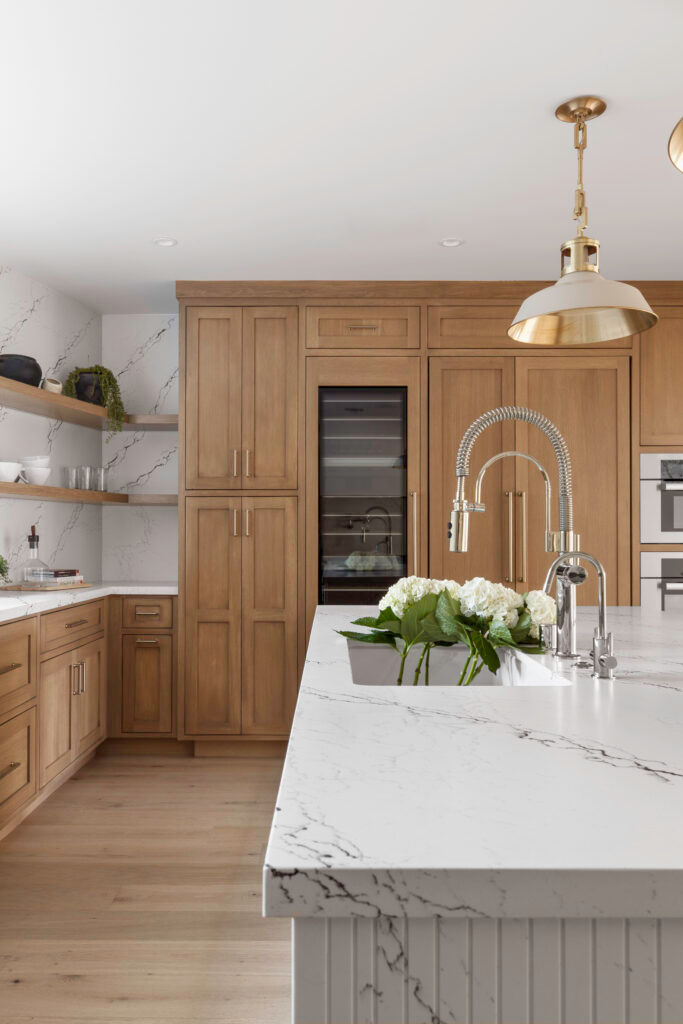
This is particularly important over dining tables and kitchen islands, where fixture size and placement have to relate to the furniture or cabinetry beneath them.
A pendant that's too small can feel insignificant. One that's too large or hung at the wrong height can overwhelm the composition or interfere with sightlines.
Lighting should look considered both on and off.
Lighting Should Be Planned Early in a Home Renovation or New Build
This is one of the biggest differences between decorating a finished room and designing a home comprehensively.
If you're undertaking a renovation or new build, the lighting plan needs to happen early.
An Interior Designer in Pacific Palisades should be thinking about lighting while the furniture plans, cabinetry elevations, ceiling conditions, and architectural details are still being developed. This is also why early collaboration between the Interior Designer, Architect, and Contractor is so important.
Why?
Because lighting affects electrical locations.
A dining chandelier needs to relate to the actual dining table—not simply the center of the room. Bedside sconces need to relate to the bed. Kitchen pendants need to relate to the island. Picture lights need artwork to illuminate. Recessed fixtures shouldn't randomly conflict with beams, cabinetry, ceiling details, or decorative fixtures.
Waiting until electrical rough-in to begin thinking seriously about lighting can mean compromising the design or paying to move things later.
The lighting plan and the rest of the design should develop together.
Don't Forget the Lighting You Don't See
Some of the most effective lighting in a home comes from fixtures you barely notice.
Under-cabinet lighting can transform a kitchen work surface. Integrated LEDs can illuminate shelving or millwork. Closet lighting can make storage considerably more functional. A subtle source tucked into an architectural detail can create atmosphere without calling attention to the fixture itself.
This is particularly useful when we want the effect of the light to be visible rather than the source.
The key is restraint.
Integrated lighting everywhere can quickly become gimmicky. Like any other design element, it should have a reason for being there.

The Designer's Trick: Dimmers and Lighting Control
One of the simplest ways to make a lighting plan more flexible is also one of the most important: dimmers.
A room rarely needs exactly the same amount of light at 8 a.m., 6 p.m., and 10 p.m.
Dimming allows the lighting to respond to different activities and moods without changing the fixtures themselves. A kitchen can be bright while you're preparing dinner and considerably softer once everyone sits down to eat. A living room can transition from daytime activity to evening entertaining with the same sources set at different levels.
Whenever appropriate, we like lighting to provide options rather than a single all-or-nothing experience.
Control is part of good lighting design.
Color Temperature Can Change Everything
Another detail homeowners often don't think about until the bulbs are installed is color temperature.
Measured in Kelvin, color temperature affects whether light appears warmer or cooler.
For many residential living spaces, warmer light tends to create the comfortable, inviting atmosphere people associate with home. But the correct specification depends on the room, the materials, the natural light, and the overall design intent.
As an Interior Designer in Pacific Palisades, we're particularly conscious of how artificial lighting interacts with the abundant natural light many homes receive during the day.
What's equally important is consistency.
Walking through an otherwise cohesive home where one fixture suddenly reads much cooler than everything around it can be surprisingly distracting. Stone, wood, paint, textiles, and even skin tones can look different under different light sources.
The lighting specification should support the material palette, not fight it.
Lighting Should Work With Natural Light
Artificial lighting is only part of the equation.
Before deciding how a room should be illuminated at night, it's worth understanding how it behaves during the day.
Where does morning light enter? Which rooms receive strong afternoon sun? Are there areas that remain naturally darker? How will window treatments filter or block that light?
For our Pacific Palisades clients, natural light can be one of the home's most beautiful assets. Rather than treating artificial lighting as a separate system, we want the two to complement one another.
A room should feel considered at noon and after sunset.
How a Pacific Palisades Interior Designer Brings It All Together
A successful lighting plan isn't created by selecting beautiful fixtures independently. It's one example of why choosing the right interior designer matters on a comprehensive home renovation or new build.
It's created by looking at the entire home.
We consider the architecture, ceiling heights, furniture plan, cabinetry, artwork, materials, natural light, sightlines, and the way each room will actually be used.
Then we decide where light is needed, what type of light should provide it, and whether the fixture itself should become part of the visual story or quietly disappear into the architecture.
That's how lighting begins to feel integrated rather than added on.
And it's why a beautiful decorative fixture alone can't rescue an otherwise poorly planned lighting scheme.
Final Thoughts
Lighting is one of the quiet heroes of great interior design.
A single source can flatten a beautifully designed room. Multiple thoughtfully placed sources can create depth, reveal texture, emphasize architecture, support everyday tasks, and completely change the atmosphere of a home.
As an Interior Designer in Pacific Palisades, we believe the best lighting plans aren't necessarily the ones you notice immediately.
You notice how the room feels.
You notice that the kitchen works beautifully at night. That the artwork has presence. That reading in bed is comfortable. That the living room becomes warmer as evening arrives. That the materials you spent months selecting actually look the way they were intended to look.
That's what thoughtful lighting can do.
And when it's planned alongside the architecture and interiors from the beginning, lighting doesn't simply illuminate the design.
It becomes part of it.
Planning a home renovation or new build and want the lighting considered frorm the beginning? Get in touch with Ethan Charles Design to discuss your project.


Comments