
Why We Love Natural Materials as a California Interior Designer
Updated: Sep 3

In a world that often leans toward fast design and fleeting trends, there is something grounding about returning to materials that come from nature- wood, stone, linen, wool, clay, leather, and metals that develop character with time.
At Ethan Charles Design, we have always been drawn to interiors that feel warm, tactile, and a little lived-in rather than overly polished or precious. As a California Interior Designer, natural materials are an important part of creating that feeling.
It might be the movement in a slab of marble, the grain of a beautiful piece of walnut, the irregular surface of handmade tile, the softness of linen, or the changing patina of an unlacquered metal finish.
These materials don't necessarily remain frozen in the condition in which they were installed, and that's part of what we love about them.
They give a home texture, variation, and character. More importantly, when chosen appropriately for how a client actually lives, they can create interiors that feel just as relevant years from now as they do on installation day.

1. Natural Materials Bring Variation and Character
There is no algorithm for nature.
Two slabs cut from the same block of stone won't necessarily have identical veining. Two boards from the same species of wood will have differences in grain and tone. Handmade clay or ceramic tile may contain subtle variations in surface, shape, or color.
That's not a defect. It's part of the material.
Natural variation creates depth that can be difficult to reproduce convincingly with something designed to look perfectly uniform.
When we're selecting stone, for example, we're not simply choosing “marble.” We're considering the individual slabs: the movement, veining, background color, scale of the pattern, and how those characteristics will appear once the material is fabricated.
The same applies to wood. Species, cut, grain, stain, finish, and even the way individual boards are composed can dramatically change the finished result.
Those decisions are why natural materials can make a home feel individual rather than mass-produced.
2. How a California Interior Designer Uses Natural Materials to Add Warmth and Texture
Some rooms are technically beautiful but still feel flat.
Often, what's missing isn't another decorative object. It's material depth.
Natural materials introduce texture almost automatically. The grain of wood sits differently beside smooth stone. Linen filters light differently than a synthetic fabric. A wool rug has a tactile quality that changes how a room feels underfoot. Handmade tile catches light differently across an imperfect surface.
As California Interior Designers, we're particularly drawn to that layered approach because it works beautifully with the relationship between indoor and outdoor living that is so much a part of California homes.
Rather than trying to make every surface perfectly uniform, we can allow materials to relate to one another through tone, texture, and contrast.
A room might combine warm oak, honed stone, linen, woven fibers, plaster, and aged metal without feeling busy because those materials share an underlying natural quality.
The result can feel elevated without feeling overly formal.
3. Natural Materials Can Age Beautifully
One of our favorite qualities in a material is its ability to become more interesting with use.
That doesn't mean every scratch, stain, or mark is desirable. And it certainly doesn't mean every natural material is appropriate for every client or application.
But many natural materials have the ability to patina rather than simply deteriorate.
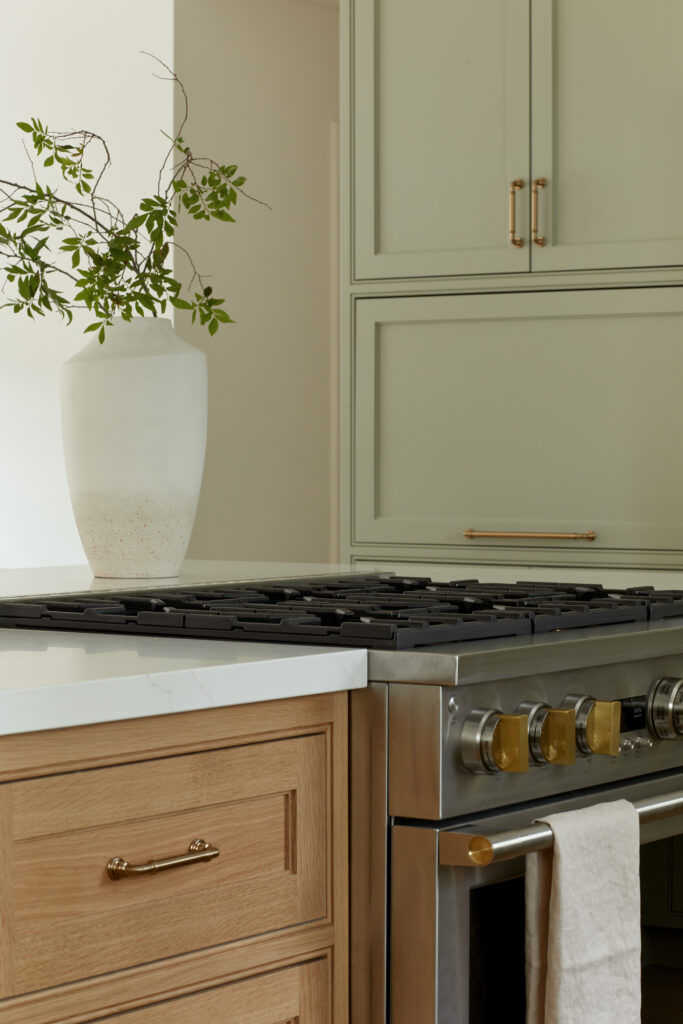
A solid wood dining table can be refinished. Certain natural stones can be honed or professionally restored. Leather can soften and deepen in character. Unlacquered brass can develop a living finish that changes as it is touched and exposed to the environment.
For some clients, that evolution is part of the appeal.
For others, a material that changes visibly with use may be exactly what they don't want, and that's important to establish before specifying it.
As California Interior Designers, our job isn't simply to choose the material we think looks best on presentation day. It's to understand how it will perform, how it should be maintained, and whether the client will still appreciate it after actually living with it.
A beautiful material is only successful if it's appropriate for the people using it.
4. Stone Is More Than a Countertop Selection
Natural stone is one of the clearest examples of why material selection is part design and part technical decision-making.
Marble, quartzite, limestone, travertine, soapstone and other natural stones don't all perform the same way. Even within a category, individual materials can vary.
We think about where the stone is being used, how much wear it will receive, the desired finish, edge details, fabrication, maintenance expectations, and how the slab's movement should be positioned within the design.
In a kitchen, the perfect slab aesthetically may not always be the best choice functionally.
In a bathroom, the finish and application can matter just as much as the color.
And when a stone has dramatic veining, slab layout and fabrication can become part of the composition itself.
The point isn't to choose natural stone simply because it's luxurious. It's to choose the right stone for the right application.

5. Wood Creates an Architectural Layer of Warmth
Few materials change the feeling of a home as immediately as wood.
We use it in cabinetry, furniture, flooring, ceilings, wall paneling, built-ins, and architectural details because it can bring warmth to spaces that might otherwise feel hard or overly pristine.
But “wood” isn't one decision.
Walnut feels different from oak. Rift-cut cabinetry reads differently from plain-sawn grain. A light natural finish creates a completely different effect from a deep stain. Matte finishes can emphasize the tactile quality of the material, while other treatments may create a more polished appearance.
We also pay attention to how many wood tones are competing within one space.
The goal isn't necessarily to make every piece of wood match. In fact, that can sometimes make a room feel overly coordinated. Instead, we want the tones to have a relationship with one another.
That subtle balance is what allows a room to feel collected rather than assembled from a matching set.
6. Handmade Materials Keep a Room From Feeling Too Perfect
There is something beautiful about seeing evidence of the person or process that made an object.
Handmade tile may have irregular edges. Plaster can have movement. Woven materials reveal their construction. Hand finished furniture can contain subtle variations that distinguish it from something produced identically thousands of times.
Those imperfections can be particularly valuable in a highly designed home.
When cabinetry is precise, stone is beautifully fabricated, and architectural lines are carefully controlled, a handmade material can keep the room from feeling sterile.
It's contrast again: refined against imperfect, smooth against textured, new against something that feels as though it already has a history.
Natural and handmade materials help us create spaces that feel considered without feeling untouchable.
7. Natural Materials Can Support More Thoughtful, Long-Term Design
Natural doesn't automatically mean sustainable.
A material's environmental impact depends on where it came from, how it was harvested or extracted, how it was manufactured, how far it traveled, how long it lasts, and what eventually happens to it.
So rather than assuming that every natural material is inherently the environmentally superior choice, we prefer to think about longevity and responsible specification.
Can the material be repaired or refinished rather than replaced?
Will it still look appropriate in ten or twenty years?
Was it sourced responsibly?
Are there reclaimed, locally produced, certified, or lower-impact options available?
Is the material durable enough for the application in which we're using it?
Sometimes the most responsible design decision is simply choosing something well enough that there is no desire, or need to replace it a few years later.
That's a philosophy that aligns naturally with our approach as California Interior Designers: fewer disposable decisions, more materials and pieces intended to remain part of the home.

8. Natural Doesn't Have to Mean Rustic
This is an important distinction.
Using natural materials does not mean a home has to look rustic, earthy, bohemian, or overtly “organic.”
A beautifully veined stone can feel incredibly contemporary. Walnut cabinetry can be sleek and architectural. Linen can be tailored. Handmade tile can sit beside modern plumbing fixtures. A wool rug can anchor an otherwise minimal room.
Natural materials are ingredients, not a predetermined style.
What matters is how they're detailed, proportioned, finished, and combined.
That's why we can use many of the same material families across very different projects without creating homes that all look alike.
Let Nature Lead the Way
At Ethan Charles Design, our work is rooted in creating homes that feel elevated but livable, warm but considered, and sophisticated without feeling overly precious.
Natural materials help us bridge those ideas.
They bring texture without unnecessary decoration. They introduce variation without requiring pattern. They can soften contemporary architecture, give new construction a sense of depth, and allow a home to develop character as it is lived in.
But using natural materials successfully isn't simply about choosing marble instead of porcelain or solid wood instead of veneer.
It's about understanding where a material belongs, how it will perform, how it will age, how it relates to everything around it, and whether it makes sense for the person who will actually live with it.
That's ultimately what makes material selection part of interior design rather than simply shopping for finishes.
And when the right materials come together, a home doesn't just look beautiful on the day it's finished.
It gets the opportunity to become even better with time.
Planning a home renovation or new build and want help developing a thoughtful material palette? Get in touch with Ethan Charles Design to discuss your project.


Comments