
How Much Does an Interior Design Project Cost in Los Angeles? A Realistic Budget Guide

Let's start with something that probably isn't going to surprise anyone: renovating, building or furnishing a home in Los Angeles can get expensive.
The more difficult question is what is this going to cost?
If you're planning a kitchen renovation, should you be thinking $50,000 or $150,000?
Does a primary bathroom cost $40,000? $75,000? $150,000?
What does it actually cost to furnish a completely empty house?
And if you're building a custom home in Los Angeles, what does a realistic construction budget even look like these days?
Unfortunately, there isn't one single answer to any of those questions.
However, there are realistic numbers that can help you determine whether the project you're envisioning and the budget you've established are speaking the same language. When trying to understand interior design project cost in Los Angeles, the scope of the project is ultimately what makes the biggest difference.
And that's what we're going to talk about and hopefully help give you some insight!
First, What Do I Mean by "Project Budget?"
This is important because people use the words project budget to mean totally different things.
One client may tell us they have a $500,000 renovation budget and mean that's what they've allocated for their general contractor.
Another may mean $500,000 for absolutely everything: construction, cabinetry, appliances, plumbing, lighting, stone, tile, furniture, window treatments, interior design fees and every other expense associated with the project.
Those are two completely different $500,000 budgets.
For the purposes of this guide, when I discuss the cost of a kitchen, bathroom or renovation, I'm generally talking about the construction, materials, fixtures and products necessary to complete that portion of the project.
When we discuss furnishings, I'll specifically explain what's included there too.
Interior design fees are not included in the project budgets discussed below. If you're trying to understand what an interior designer costs and how professional design fees are structured, I wrote an entire separate guide about exactly that.
These numbers are also by no means minimum project requirements for Ethan Charles Design, nor are they quotations for or from any particular project. They're planning numbers intended to help homeowners understand the financial realities of professionally designed residential projects in Los Angeles.
Can You Renovate for Less Than the Numbers in This Guide?
Absolutely, and I want to make that clear before I give you any numbers.
You can hire individual trades yourself.
You can act as your own general contractor.
You can select more economical materials.
You can keep every plumbing fixture exactly where it is.
You can use stock cabinetry instead of custom cabinetry or even refinish your existing cabinetry.
You can shop retail instead of using an interior designer.
You can renovate a perfectly lovely home for considerably less money than some of the budgets we're going to discuss especially depending on your geographic location.
The numbers in this guide assume something different.
We're generally talking about projects being professionally designed and executed by an established, licensed, insured and bonded general contractor, along with the skilled trades required to execute the work properly.
That distinction matters.
There is a meaningful cost difference between hiring and managing individual trades yourself and hiring an established general contractor to coordinate a professionally designed residential project. There is also a meaningful stress level difference between the two.
There are also different levels of interior design firms.
Every interior designer has a different standard for materials, detailing, craftsmanship and finished work they're comfortable putting their name on. A budget that works perfectly well for one design firm may be difficult for another, not because one of them is necessarily right or wrong, but because they're designing different projects for different clients at different levels of the market.
So, when I say a particular budget is a comfortable place to begin planning, I am absolutely not saying the project literally cannot be completed for less.
I'm saying this is where I would begin the conversation if your goal is an elevated, professionally designed and professionally executed result in Los Angeles and similar markets.
A Good Budget Isn't About Making Everything Expensive
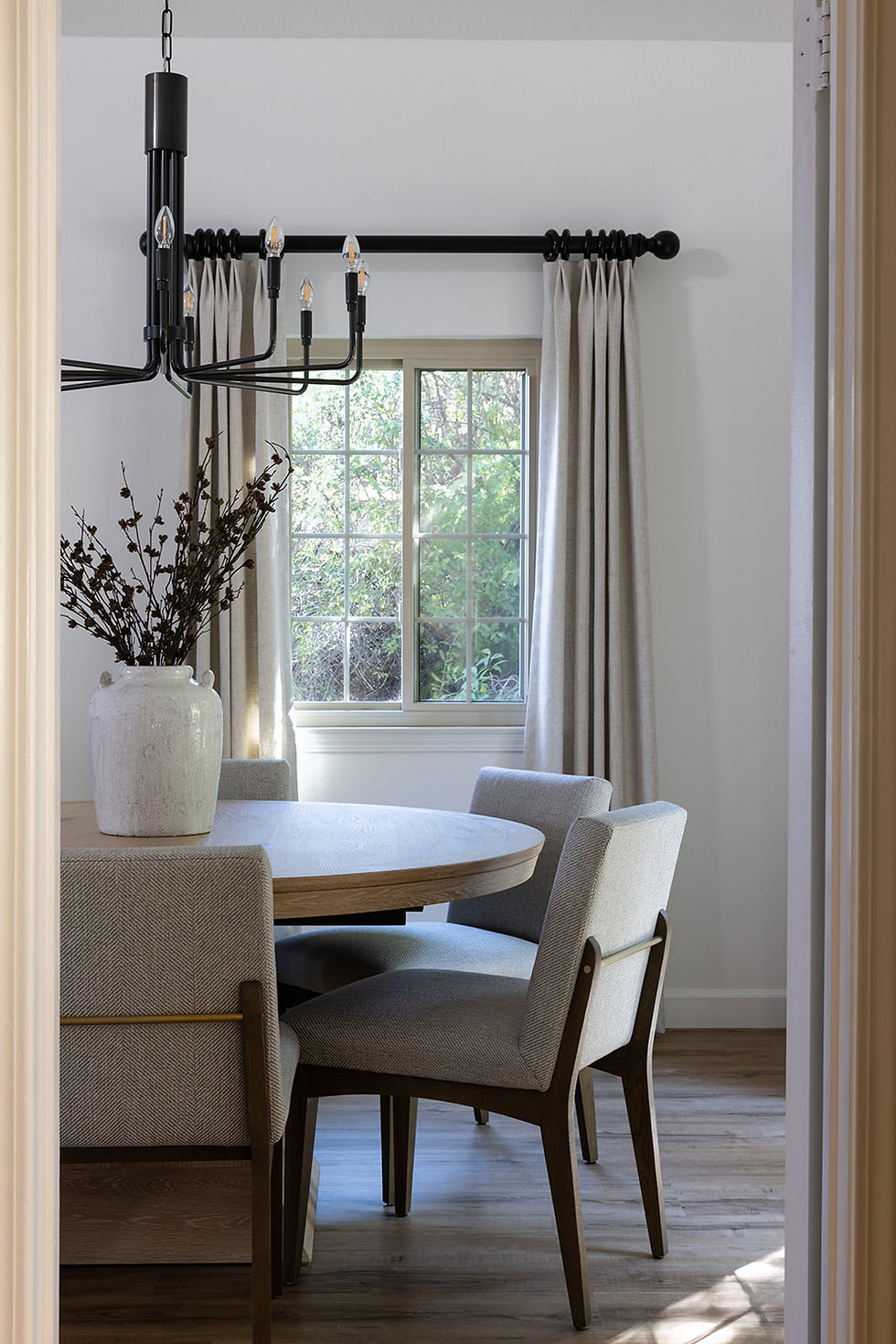
This is without a doubt worth saying.
Good interior design does not mean choosing the most expensive option every time, and quality does not automatically mean choosing the most expensive option either.
In fact, a good interior designer is a steward of your money. They should know how the budget should be properly allocated, and this is probably one of the most important parts of our job- understanding how best to utilize and distribute your budget where it matters most.
Maybe we splurge on the stone but find less expensive tile.
Maybe the sofa is an investment and the side table isn't.
Maybe custom cabinetry is important in the kitchen, but the secondary bathroom vanity doesn't need to be an heirloom.
I've designed bathrooms where a relatively inexpensive slab was used across multiple spaces, and I've designed kitchens where the appliance package alone cost more than some entire kitchen renovations.
Both can result in equally beautiful work.
The goal isn't to spend money for the sake of spending money.
It's to allocate the budget in a way that supports the design and your goals.
How Much Does a Kitchen Renovation Cost in Los Angeles?
Let's start with the kitchen because this is usually where budgets get interesting very quickly.
For a medium-sized, fully renovated kitchen with custom cabinetry, quality appliances, stone, plumbing fixtures, lighting, hardware and professional construction, I think approximately $125,000-$250,000+ is a realistic planning range in Los Angeles today.
Can you renovate a kitchen for $100,000?
Absolutely.
You can maybe even do it for less.
Keeping the existing layout, being disciplined about the appliance package, controlling cabinetry costs, having little to no structural changes and making strategic material selections can move the number substantially.
But once you begin layering fully custom cabinetry, premium or luxury appliances, stone, specialty lighting and plumbing, detailed fabrication and an established general contractor into the project, $125,000 stops sounding particularly extraordinary.
To put that into perspective, imagine a kitchen with a $45,000 appliance package and $45,000 worth of custom cabinetry.
You're already at $90,000.
Add plumbing fixtures, countertops and backsplash, decorative lighting, cabinet hardware, fabrication and installation and you can move well beyond $100,000 before much of the actual construction labor has even entered the conversation.
That's how a kitchen approaches $200,000 without anyone making a single outrageous decision.
And, of course, large or highly customized kitchens can go well beyond that.
What Makes a Kitchen More Expensive?
The biggest variables tend to be:
Size
Fully custom cabinetry vs. not
Appliance package
Amount and type of stone
Layout changes
Structural work
Plumbing and electrical relocation
Decorative and architectural lighting
Specialty finishes
Complexity of fabrication and installation
A $100,000 kitchen and a $250,000 kitchen may be approximately the same size.
They're simply not the same kitchen.
How Much Does a Primary Bathroom Renovation Cost in Los Angeles?

Bathrooms are deceptive because they're relatively small spaces with an enormous concentration of expensive things.
Plumbing.
Tile.
Stone.
Glass.
Cabinetry.
Electrical.
Waterproofing.
Fixtures.
Labor.
It's all packed into a relatively tiny footprint.
For a medium-to-large primary bathroom, I think approximately $75,000-$150,000+ is a comfortable planning range for the caliber of project we're discussing.
That does not mean every primary bathroom needs $75,000.
A smaller primary bathroom that retains its existing layout and uses materials strategically may come in considerably below that.
But once you're talking about a larger room with a custom vanity, substantial tile or stone, premium or luxury plumbing fixtures, custom shower glass, a freestanding tub, specialty lighting, heated floors or significant layout changes, getting into six figures is not remotely difficult.
And a highly customized primary bathroom can move well beyond $150,000.
What Makes a Primary Bathroom More Expensive?
Size matters, but so does:
Moving plumbing
Custom cabinetry
Natural stone and slab applications
Premium or luxury plumbing fixtures
Steam showers
Heated floors
Custom shower glass
Specialty lighting
Structural changes
Complicated tile installation
Large-format or book-matched stone
High levels of customization
Again, could you build a beautiful primary bathroom for $60,000 or less?
Absolutely.
The question is what bathroom you're trying to build.
What About a Secondary or Guest Bathroom?
Secondary bathrooms generally require less investment, but I still think people are often surprised by how quickly the numbers add up.
For a fully renovated secondary bathroom, approximately $35,000-$60,000+ is a useful planning range.
At the lower end, we're usually talking about a relatively straightforward bathroom where the existing footprint remains intact and materials are selected thoughtfully.
As custom cabinetry, more expensive tile, natural stone, upgraded plumbing, custom shower glass, complicated installation or layout changes enter the project, the number moves quickly.
And yes, secondary bathrooms can absolutely exceed $60,000.
The important thing to remember is that smaller does not always mean inexpensive.
A small bathroom still needs a plumber.
It still needs an electrician.
It still needs proper waterproofing.
It still needs tile installation.
It still needs fixtures.
It still needs a contractor to coordinate all of it.
There are simply fewer square feet over which to spread those costs.
How Much Does It Cost to Furnish a Living Room?
Furniture is where pricing becomes incredibly difficult to generalize because two sofas can look similar in a photograph and differ in price by $15,000+.
For a complete, elevated living room furnished from scratch, I think approximately $50,000-$100,000+ is a useful planning range, including the ancillary costs required to actually get everything into the house.
A $40,000 room can absolutely be done and possibly even for less.
It simply requires more discipline about where the money goes.
At around $50,000, there's generally more flexibility to create a complete room without compromising every other selection. At $60,000 and above, there's substantially more room for better upholstery, rugs, window treatments, lighting and specialty pieces.
And $100,000 is by no means a ceiling.
A single handmade rug, antique, collectible piece or custom sofa can change the equation very quickly.
For context, a recent living room we designed included a sectional, rug, coffee table, console, two lamps, two ottomans, pillows and accessories. The furnishings and accessories themselves were already in the mid-$30,000 range before sales tax, freight, receiving, storage, and delivery were added.
The room turned out beautiful, but nothing about the room was particularly outrageous.
That's simply what quality furniture costs.
Don't Forget the Costs Beyond the Furniture
This is one of the most common things people overlook when establishing a furnishing budget.
The sofa has to get to you.
So does the rug.
And the table.
And the 300-pound dining table.
Depending on the project, a furnishing budget may also need to account for:
Sales tax
Freight and shipping
Receiving
Inspection
Storage
White-glove delivery
Installation
Window-treatment fabrication and installation
Those costs are real and should be part of the conversation from the beginning.
How Much Does It Cost to Furnish an Entire House?

For a completely empty home being furnished from scratch at an elevated level, approximately $100 per square foot can be a useful early planning benchmark.
So, for a 3,000-square-foot house, that would mean beginning the conversation around $300,000.
Can you furnish that same house beautifully for $200,000-$250,000, or maybe even less?
Yes.
But the size of the rooms, number of pieces required, level of customization and brands being used will determine how much flexibility you have.
At higher levels of the market, furnishing budgets can easily reach $150–$200+ per square foot, and large luxury residences can move well into seven figures.
A 6,000-square-foot house furnished at $150 per square foot is already a $900,000 furnishing project.
And that's before somebody decides they a custom hand knotted silk rug.
This is also why I don't particularly love using a home's value to establish a furnishing budget.
You will sometimes hear recommendations to budget 10–20% of the home's value for furnishings. That may be a useful exercise in some markets, but in Los Angeles, where land and location can represent an enormous portion of a property's value, it can become misleading very quickly.
A $5 million house in one neighborhood and a $5 million house in another may be completely different homes.
I personally would rather look at the actual house and talk with my clients to determine what it takes to furnish it properly.
What Does a Whole-Home Renovation Cost in Los Angeles?
This is where giving someone a single number becomes incredibly dangerous.
Let's take a roughly 3,000-square-foot home receiving a substantial interior renovation. Meaning we are touching every part of the home.
We're renovating the kitchen.
We're renovating the primary bathroom.
We're renovating both secondary bathrooms and a powder bath.
We're replacing flooring.
We're updating lighting.
We're painting.
We’re replacing windows and doors.
We're adding cabinetry and millwork where appropriate.
We're changing plumbing fixtures, tile, stone and hardware.
We're making the house feel substantially different when we're finished.
For that level of work, approximately $500,000-$1 million+ is a reasonable early planning range, before professional interior design fees and furnishings.
And frankly, $500,000 could still require some careful decision-making depending on the house.
That doesn't mean every 3,000-square-foot renovation costs half a million dollars.
A house receiving primarily cosmetic improvements is a completely different project.
It also doesn't mean $1 million is a ceiling.
A comprehensive gut renovation involving major structural changes, new building systems, extensive custom millwork, windows and doors, significant architectural modifications and highly customized finishes can move substantially beyond that.
Why I Don't Love Pricing Renovations by Square Foot
Square footage can be useful, but it's an imperfect tool for renovations.
A 3,000-square-foot house with one kitchen and two bathrooms is not the same project as a 3,000-square-foot house with one kitchen, five bathrooms, a laundry room, a bar and tons of built-ins.
The kitchen may consume $175,000 or more in a few hundred square feet.
A bedroom may only need new flooring, lighting and paint.
Those spaces shouldn't be treated as though they cost the same amount per square foot simply because they're under the same roof.
Scope matters more.
How Much Does It Cost to Build a Custom Home in Los Angeles?

Ground-up construction is another category where price-per-square-foot numbers need a lot of context.
For an elevated custom home in Los Angeles, I think approximately $750 per square foot and up is a reasonable place to begin an early budgeting conversation for the cost to actually build and finish the home.
Can a custom home be built for $500 per square foot?
Absolutely.
There are contractors and projects that achieve it.
But site conditions, architecture, structural complexity, material selections, level of customization, where the home is located, and the construction team can move that number dramatically.
At $750 per square foot:
A 3,000-square-foot home represents approximately $2.25 million.
A 5,000-square-foot home represents approximately $3.75 million.
A 7,000-square-foot home represents approximately $5.25 million.
And high-end custom construction can move very substantially above those figures.
Where in Los Angeles You're Building Matters
Los Angeles isn't one construction market.
Building in Sherman Oaks or parts of the San Fernando Valley can present a very different set of conditions from building in Brentwood, Bel Air, Beverly Hills, Pacific Palisades or Malibu.
Hillside construction can require complicated foundations, retaining walls, difficult site access, geotechnical work and additional engineering.
Coastal conditions can introduce another set of requirements.
And highly affluent neighborhoods frequently involve larger homes, more complicated architecture, higher levels of customization and construction teams accustomed to executing at a different level of the market.
The same principle applies beyond Los Angeles and even California.
A highly customized home in Calabasas or a large estate renovation in Montecito may involve completely different expectations, site conditions and levels of finish than a more straightforward project elsewhere in Southern California.
A zip code doesn't automatically determine what a project costs.
But location absolutely can affect it.
The Contractor You Hire Matters Too
Just as interior designers operate at different levels of the market, so do contractors.
Being licensed is important.
But a contractor who primarily completes straightforward $100,000 renovations and a contractor whose portfolio consists of highly detailed multi-million-dollar custom homes are running different businesses.
Their staffing is different.
Their subcontractors may be different.
Their supervision may be different.
Their processes may be different.
And their pricing is likely very different.
That's another reason one homeowner can tell you their renovation cost $300,000 while someone else with a similarly sized house tells you they spent $800,000.
They may not have purchased the same level of project at all.
The Original Contractor Estimate May Not Be the Whole Project Budget
This deserves its own section because it causes an enormous amount of confusion.
A contractor may give you a construction estimate that does not include every item eventually required to finish the house.
Depending on how the project is structured, cabinetry, appliances, plumbing fixtures, decorative lighting, tile, stone, hardware and other materials may be purchased separately by the homeowner or interior designer.
So, a "$2 million construction contract" does not necessarily mean the house costs $2 million to build.
You need to understand what is actually included in that number.
When establishing a project budget, I care much more about the amount required to complete the home than which particular spreadsheet or contract each expense happens to live on.
Why Projects in Brentwood, Beverly Hills or Bel Air Can Cost More

There isn't a secret Beverly Hills tax that automatically doubles the cost of your bathroom the moment you cross into the 90210 zip code.
But geography does affect construction.
Homes in Beverly Hills, Bel Air, Brentwood, Pacific Palisades, Malibu, Calabasas, Montecito and other luxury residential markets may come with larger footprints, hillside sites, difficult access, complicated permitting, more extensive architecture and even more than those reasons- a higher expected level of finish.
The contractors and trades working regularly on those projects may also operate at a different level of the market.
That's why I would be cautious about taking a renovation budget from one neighborhood and assuming it transfers perfectly to another.
The house matters.
The site matters.
The team matters.
And the expectations matter.
What Happens If Your Budget Is Below These Numbers?
Please don't read this article and assume that being below one of these ranges means you shouldn't call an interior designer.
That's not the point.
If you're planning a $125,000 kitchen and have $100,000 available, that doesn't necessarily mean the project is dead.
It means we need to have a conversation about priorities.
Maybe we retain the existing flooring.
Maybe we simplify the cabinetry.
Maybe the appliance package changes.
Maybe we use a pricier stone somewhere it matters and a less expensive material somewhere it doesn't.
Maybe we keep the plumbing where it is.
Sometimes the budget and the wish list are simply too far apart.
But sometimes they're close enough that good decisions can bridge the gap.
A realistic budget should help guide the design- not automatically disqualify you from it.
So, What Should You Actually Budget?
If you're at the very beginning of planning, these are the numbers I would use as conversation starters for an elevated, professionally designed residential project:
As a reminder these figures are intended to give you breathing room for an elevated, professionally executed project- not to define the lowest price at which the work can be done.
Secondary bathroom: approximately $35,000-$60,000+
Medium-to-large primary bathroom: approximately $75,000-$150,000+
Medium-sized kitchen renovation: approximately $125,000-$250,000+
Complete living-room furnishings: approximately $50,000-$100,000+
Whole-home furnishings: approximately $100 per square foot as an early planning benchmark, with higher-end projects reaching $150-$200+ per square foot
Substantial 3,000-square-foot interior renovation: approximately $500,000-$1 million+
Elevated ground-up custom construction in Los Angeles: approximately $750+ per square foot as an early planning benchmark
Again, professional interior design fees are additional to these figures, and none of these numbers should be treated as a quotation, universal minimum or guarantee.
You may spend less.
You may spend considerably more.
What matters is whether the budget, scope, team and expectations are aligned.
Because at the end of the day, the question isn't simply:
"How much does a renovation cost?"
It's:
"How much does the renovation I'm actually imagining and wanting cost?"
And that's a much more useful question to answer.
HAVE A PROJECT IN MIND?
Every project has a different scope, budget and set of priorities. If you're planning a renovation, new construction or furnishing project in Los Angeles, Southern California or beyond, we'd love to hear what you're working on.
Tell us about your project and let's see if we're a good fit.


Comments