
Things Interior Designers Wish You’d Stop Doing
Updated: Sep 3
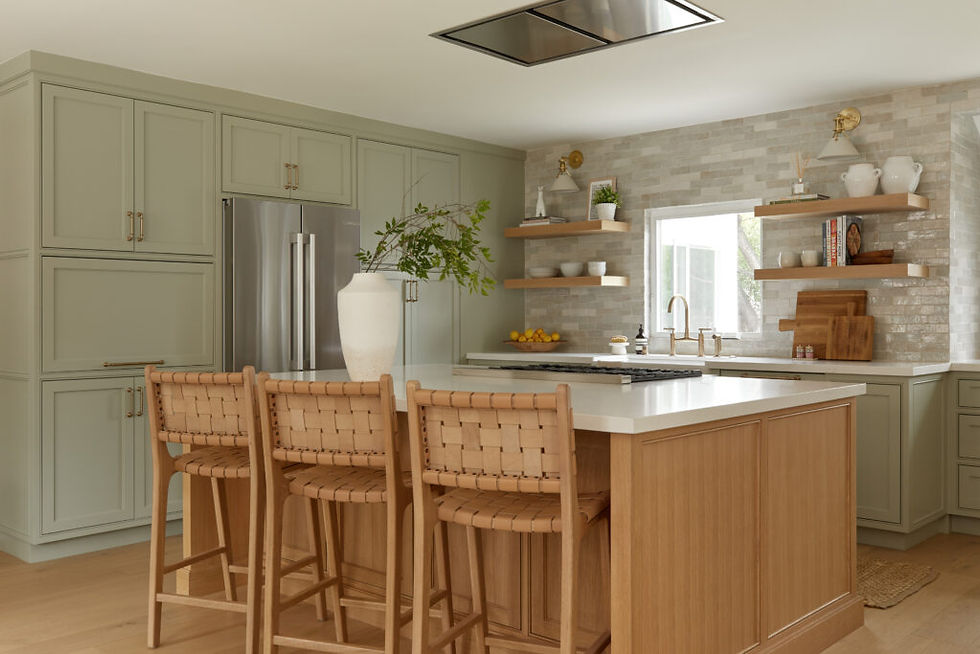
Every profession has its “please don’t” list, the things people outside the industry may not realize can make a project harder, more expensive, or ultimately less successful. Interior designers are no different.
And while some of our pet peeves are purely aesthetic, many of them have much more to do with protecting the design, the budget, and the experience of creating a home.
As an Interior Designer in Pacific Palisades, much of our work happens long before the final styling and photography. We’re thinking about floor plans, construction details, cabinetry, materials, lighting, furniture scale, lead times, installation, and hundreds of decisions that eventually have to work together.
So, with a little humor and a lot of experience behind them, here are seven things interior designers really wish you’d stop doing.

1. Not Hiring an Interior Designer in the Pacific Palisades Early Enough
We understand why some homeowners initially think they can handle the design themselves. There is more access to furniture, materials, inspiration, and design information than ever before. But having access to those things and knowing how to put them together are two very different things.
A good Interior Designer in Pacific Palisades isn't simply there to choose paint colors and throw pillows. Depending on the project, we're thinking about space planning, cabinetry, lighting, plumbing, tile and stone, flooring, hardware, furniture, window treatments, and how all of those decisions relate to one another.
On a renovation or new build, the designer may also be reviewing plans, developing elevations, coordinating with the architect and contractor, answering questions from trades, and making decisions months before you'll ever see the finished room.
Bringing a designer into the project early gives them the opportunity to help establish that bigger picture before individual decisions begin locking you into a direction.
2. Bringing Us On Halfway Through the Building Process
Imagine baking a cake and inviting someone to help once it's already in the oven, only to discover that the ingredients needed to change before it went in. That's essentially what happens when a designer is brought into a renovation after the floor plan is finalized, electrical locations are established, cabinetry is ordered, or construction is already underway.
An experienced Interior Designer in Pacific Palisades can often make the greatest impact before those decisions become expensive to change.
Maybe the kitchen island needs another six inches of clearance. Perhaps the bathroom layout works technically but leaves nowhere useful for towel bars. The furniture plan might reveal that an outlet, sconce, or floor register is landing in exactly the wrong place. A cabinetry elevation may expose a proportion that wasn't apparent on the floor plan.
These aren't necessarily dramatic changes individually. But collectively, they're what make a finished home feel considered.
If you're building or undertaking a substantial renovation, involve your designer while the architect and contractor still have the flexibility to collaborate, not after every major decision has already been made.

3. Thinking We’re Miracle Workers
We love ambitious projects. We love realistic timelines even more.
No, we cannot completely remodel your kitchen in two weeks, furnish an entire house in three, or magically produce an exact discontinued tile from 1994 because somebody saved it to Pinterest.
Design takes time because many of the things going into a thoughtfully designed home take time.
An Interior Designer in Pacific Palisades may be coordinating custom furniture, cabinetry, stone fabrication, window treatments, lighting, wallpaper, upholstery, contractors, installers, and dozens of vendors and trades. Some pieces are made to order. Others can't be fabricated until field measurements are taken. Construction itself has sequences that can't simply be skipped.
And sometimes things go wrong. A material arrives damaged. A fabric gets backordered. Something unexpected is discovered inside a wall. A custom piece takes longer than anticipated.
A good designer's job isn't to promise that none of those things will ever happen. It's to anticipate as much as possible, communicate clearly when something does happen, and find the best solution without compromising the overall project.
A beautiful home is worth allowing the process necessary to create it properly.
4. Putting Something on Every Wall
Not every blank wall is asking for something.
Negative space is one of the most useful, and underestimated tools in interior design. When every available wall receives artwork, shelving, a mirror, or some other decorative element, the things that actually deserve attention can lose their impact.
An Interior Designer in Pacific Palisades may intentionally leave a wall completely bare because the room needs somewhere for the eye to rest.
We look at the entire composition: architecture, furniture, artwork, lighting, windows, views, and the relationships between them. Sometimes one large piece of art is stronger than a gallery wall. Sometimes a sculptural light fixture is enough. And sometimes the best thing to put on a wall is absolutely nothing.
Editing is part of designing.

5. Kitchen Cabinets That Don’t Go All the Way to the Ceiling
We clearly have feelings about this one.
When kitchen cabinets stop arbitrarily below a standard-height ceiling, the gap above them can create a dust-collecting ledge, sacrifice useful storage, and introduce another horizontal line that visually shortens the room.
In many kitchens, an Interior Designer in Pacific Palisades will recommend taking cabinetry to the ceiling or creating an intentional architectural transition at the top. The result can make the cabinetry feel more integrated, more custom, and more proportional to the room.
But, and this is important, cabinets do not have to reach the ceiling in every kitchen.
Very tall or vaulted ceilings, exposed beams, unusual rooflines, clerestory windows, budget considerations, or an intentionally furniture-like cabinetry design can all make another solution more appropriate.
The issue isn't simply whether the cabinet physically touches the ceiling. It's whether where it stops looks intentional.
That's the difference between following a design rule and actually designing the room.
6. Letting Your Sofa Take Over the Entire Living Room
We love a comfortable sofa as much as anyone. But bigger isn't automatically better.
An oversized sectional can consume a room, interrupt circulation, block sightlines, and leave little opportunity to create different seating relationships.
Before selecting furniture, an Interior Designer in Pacific Palisades should be thinking about the floor plan first: how people enter the room, how they move through it, where conversation happens, where tables need to sit, how the rug relates to the furniture, and whether the scale of everything makes sense together.
Sometimes a sectional is absolutely the right answer. Other times, a sofa paired with lounge chairs creates a much more flexible and inviting room.
And this is why buying the sofa first and figuring out everything else afterward can become a problem.
Furniture isn't a collection of individual objects. It's a composition.
The best room isn't necessarily the one that accommodates the largest possible sofa. It's the one where the furniture feels appropriately scaled to the architecture and supports how you actually want to live.
7. Using Schluter Everywhere
Let's clarify something first: Schluter isn't inherently bad.
Metal tile profiles have a legitimate purpose, and there are installations where they can be an appropriate, clean, and practical way to finish an exposed tile edge.
What we wish people would stop doing is treating visible metal edging as the automatic solution for every tile condition without considering what the finished detail will actually look like.
A skilled Interior Designer in Pacific Palisades should be thinking about those transitions while the tile is being specified, not after the installer is standing there asking how to finish the edge.
Depending on the tile, architecture, and application, alternatives might include mitered tile edges, stone jambs or returns, finished-edge tile pieces, trim profiles, or another custom detail. Each option has implications for material, fabrication, labor, cost, and installation.
And sometimes Schluter really is the right answer.
The point is to make that choice intentionally.
The smallest construction details can have an outsized effect on how refined a finished bathroom or kitchen feels.

The Big Picture
If there is one theme connecting everything on this list, it's that good interior design involves much more than making things look pretty.
It's planning ahead.
It's understanding proportion.
It's knowing how one decision affects another.
It's recognizing when a “rule” should be followed, and when the better design requires breaking it.
And it's coordinating hundreds of individual details so that, when the project is finally complete, none of that complexity is what you notice.
Working with the right Interior Designer in Pacific Palisades means having someone who can think beyond the individual sofa, cabinet, tile, or paint color and consider how all of those decisions come together to create a home that works for the way you live.
So bring your designer in early. Give the process the time it deserves. Don't buy a sofa simply because it's enormous. Let a blank wall breathe occasionally. And please, let's discuss the tile edge before the tile installer needs an answer.
Your future home will thank you.
Ready to discuss your own renovation, new construction, or furnishing project? Get in touch with Ethan Charles Design.


Comments